

Kyllinga Control
Kyllinga has become a significant issue for lawns in New Jersey. Kyllinga is an invasive, creeping sedge weed that spreads rapidly through its underground stems, called rhizomes, which grow quickly to form low clumps that expand into dense mats, displacing the desired grass. This dense mat makes it appear similar to turfgrass in the summertime, but it usually has a lighter green color that clashes with normal green healthy grass blades, leading to large areas of discoloration. When it blooms in late summer, it produces a round green flowering seedhead surrounded by three long, narrow leaves at the base of the seedhead.

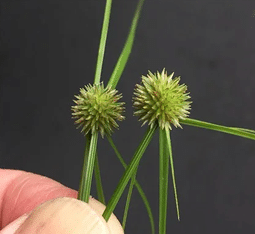
Kyllinga thrives in wet, low-lying areas. Kyllinga acts as a parasite, turning an otherwise level-surfaced, uniform, and aesthetically appealing lawn into an uneven yard with different colors and textures, not to mention forming a weak sod that results in poor grass roots. In the fall, kyllinga enters its dormant stage, making it much easier to identify due to turning an unsightly rust color that is spread throughout the lawn.
There is a short window of opportunity to effectively control kyllinga. The best time for chemical control is when the plant first emerges in late spring/early summer. Our program consists of a series of 3 treatments targeting kyllinga that is applied late May through late August.
Our expert technicians at GSU can identify if kyllinga is present in your lawn. If it is identified in your lawn, we highly recommend scheduling treatments, as kyllinga is a perennial sedge that readily reoccurs year after year.
